With the advancement of technologies and the increasing connectivity of the world, we see that networks are essential for all our communication processes, ranging from browsing the internet to playing games and even working remotely. Ports come into play here, providing means of connection for different devices. Yet, sometimes it may be difficult to find out whether a certain port is open, closed, or blocked. In such cases, a ‘port checker’ becomes helpful.
A port finder can be described as a useful tool aimed at helping users check various ports on their servers or devices. Regardless of your experience in dealing with computer technologies, understanding how to use port detectors proves itself helpful for both beginners and more experienced users.
Why Use a Port Finder?
The port scanner is one of the most useful tools to be used in various situations, particularly when there is involvement of networks or servers. It can help identify issues related to the network and can help determine whether a website or application fails to work because a particular port is blocked. It proves to be quite helpful while setting up a firewall, since it helps keep those ports that are not needed closed and only the essential ones kept open. It proves to be quite helpful in case of setting up a server like the web server, gaming server, or email server.
In addition, it is very useful in conducting security assessments by determining whether there are any open ports that can be used as an entry point by hackers. Lastly, when setting up remote connection software such as SSH or Remote Desktop, the port testing tool is important because it will help you confirm whether the ports are reachable from external sources.
How to Use a Port Status Checker
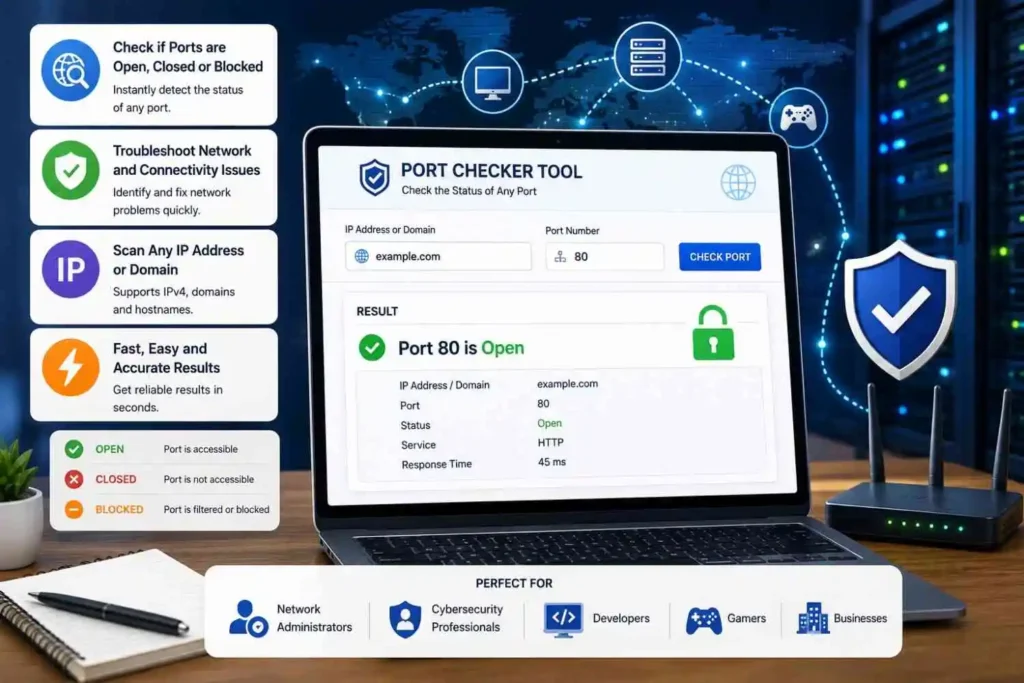
It is very simple to operate a socket tester, and this tool has been designed to suit individuals who lack enough technical skills. The first thing an individual can do to perform a port check is select a network scanner from the wide variety of port access tools available. It could either be a web-based port checker, where an individual uses it online, or be downloaded and installed on a computer to get more functionalities. The second download requires entering the IP address or the website URL of the computer from which one wishes to check its ports. The last step entails entering the port number that an individual wants to check.
After filling out all the necessary information, you may initiate the entire procedure by pressing the button labeled “check,” “scan,” or anything similar to these words. The program will then begin making inquiries about the particular port and receiving the responses. Within a few seconds, the program will give you the results, telling you if the port is open, closed, or filtered. It would be best if you repeated this process a number of times and perhaps used other programs to have accurate results.
Common Issues Detected by Port Testers
A port scanner can prove to be very helpful in troubleshooting different kinds of network problems. First of all, it will help in spotting blocked ports, which happen due to firewalls or ISPs blocking certain ports, thus creating problems in connecting through those ports. Another common problem that a port scanner will help in diagnosing is that of misconfiguration in port forwarding, where the router configuration might make the port look closed. At times, a port might actually be open, but the required service will not be available, thus making the connection impossible. Lastly, a port scanner will also help in identifying any kind of ISP restrictions, where ISPs restrict certain ports due to their policy or security concerns.
Conclusion
Port Checker is one of the simplest and most important tools used by those who work in networking, website development, and online services. With its help, you can easily find out whether certain ports are open, closed, or blocked, which allows you to detect and solve problems as well as secure your network. For newcomers to networking, a port verification tool is a great introduction into the topic. As for experienced professionals, they consider such a tool one of the necessary elements of checking their systems.
FAQ’s
Q1. When a port is described as open, what does this imply?
This implies that some application is active and waiting to accept connections through that port.
Q2. If the port is referred to as being closed, what can be said about this situation?
It means that there is no application running on that particular port at that time.
Q3. Is it possible for the port checker to detect any security threats?
Port analyzers cannot detect any threat, although they can help us detect open ports that can become a risk in case they are not adequately protected.